What the French call their loved ones
As a French child, I was called many things by my parents, cousins, even strangers on the street! And I never realised until I learned new languages how special these pet names were to me. I tried translating them into English for my husband, but it just doesn’t sound the same. The same is true vice versa by the way – I cannot call my husband “miel” (honey) in French! But what I can do is share some of them with you, so that you can maybe pass them on to your Francophile friends, or even just use them as is, in French, for your spouses, family or other loved ones.
How the French do it
The French have got an entire zoo, a farmer’s market, and a patisserie’s worth of affectionate nicknames. And they use them liberally, on partners, children, friends, sometimes even colleagues if the mood strikes.
If you’re new to French culture, prepare yourself. You will be called a cabbage. You will be someone’s flea. You might even be a shrimp. And somehow, impossibly, it will all sound romantic.
In French culture using diminutives and playful language is a way to show affection. Where English speakers might feel a bit silly calling their grown partner “my little chicken,” the French lean right into it! It’s not considered childish or over-the-top, it’s just… normal.
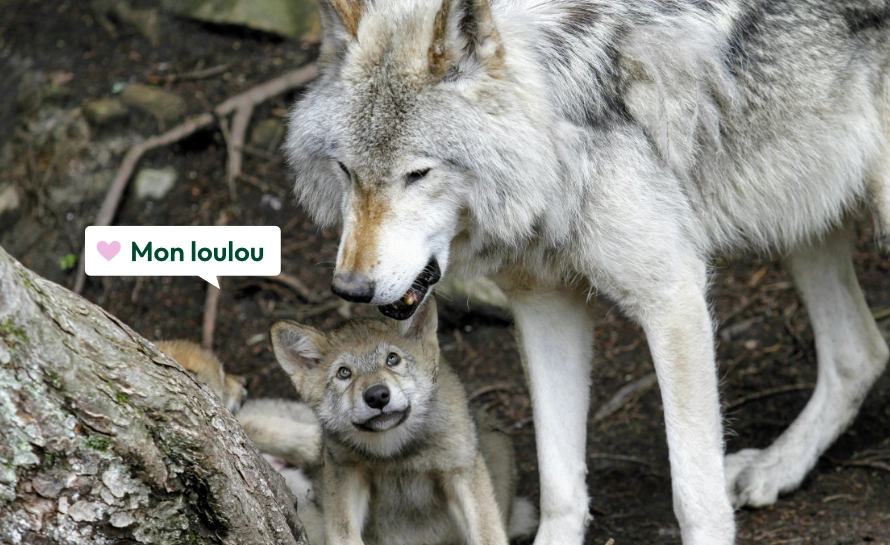
Part of it comes from the French language itself, which loves diminutives. Adding “-ette” or “-ou” to the end of words makes them cuter, smaller, more precious. A “poule” (hen) becomes “ma poulette.” A “loup” (wolf) becomes “mon loulou.” The language practically begs you to make things adorable.
French terms of endearment – The animals
French terms of endearment are heavily populated with animals. Not majestic ones, mind you, forget lions and eagles. The French prefer the small, the cute, the farmyard.
“Ma puce” (my flea) is everywhere. Yes, a flea. The logic? Fleas are tiny and they jump on you affectionately. Once you get past the initial weirdness, it’s actually quite sweet. This one’s huge for children but works for partners too.
“Mon lapin” or “ma lapine” (my rabbit) is common between couples and has a slightly sexy edge to it. Rabbits, after all, have a certain reputation.
“Ma biche” (my doe) is gentle and romantic. “Mon chat” or “ma chatte” (my cat) works for partners, though “ma chatte” can be a bit risqué. I’ll let you figure out why in your own time. “Mon chaton” (my kitten) is safer territory.
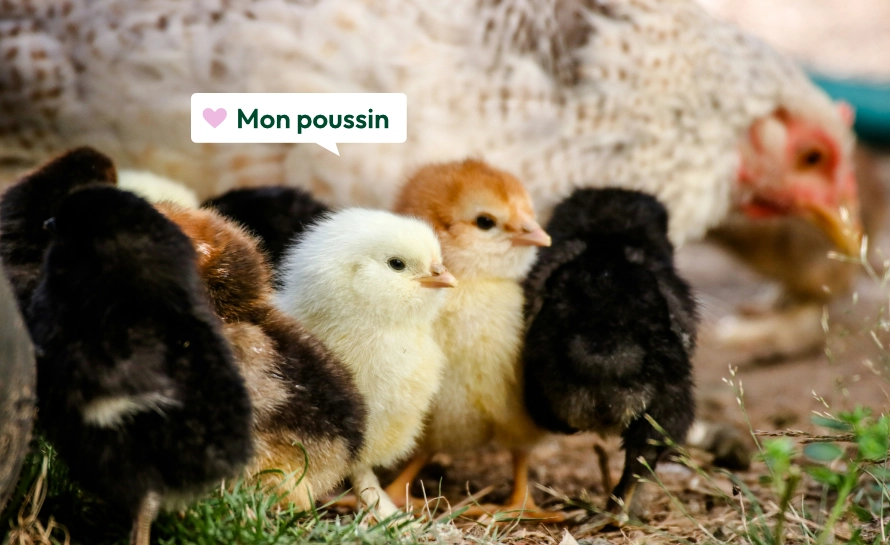
Then there’s the poultry section. “Ma poule” (my hen) is very maternal, something a mother or grandmother might say. “Mon poulet” (my chicken) works for children. “Ma cocotte” (little hen) is playful and affectionate. “Mon poussin” (my chick) is almost exclusively for small children.
“Mon canard” (my duck), “ma tourterelle” (my turtledove), “ma colombe” (my dove), even “mon pigeon” (yes, pigeon), the French will grab any bird that waddles or coos and turn it into a term of endearment.
French terms of endearment with animals
Ma puce
Ma biche
Ma poule
Ma cocotte
Ma colombe
Ma tourterelle
Mon chaton
Mon canard
Mon lapin
Mon chat
Mon pigeon
Mon poussin
French terms of endearment – The food
If the animal kingdom wasn’t enough, French nicknames also plunder the pantry.
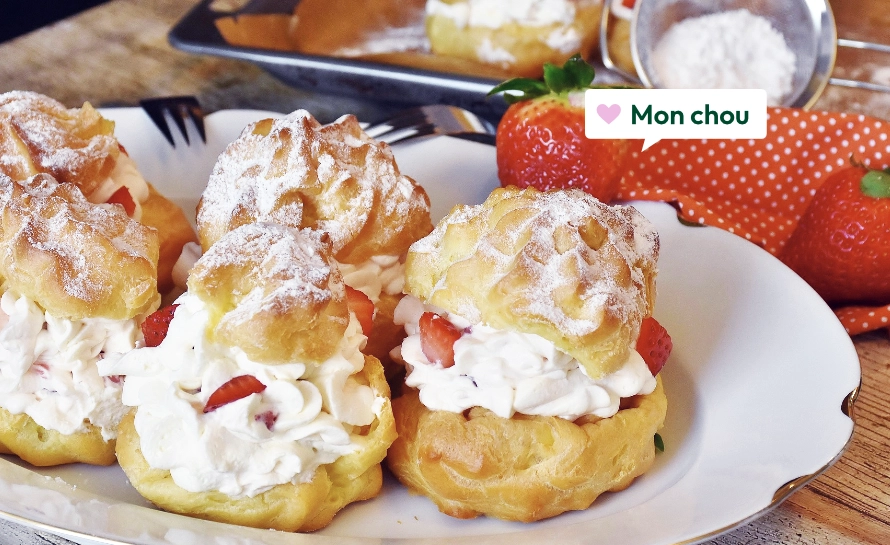
“Mon chou” is the big one. My cabbage. It sounds absurd in English, but it’s one of the most common French terms of endearment. The theory is it’s actually short for “chou à la crème” (cream puff), which makes more sense. Either way, being called a cabbage is a sign of deep affection.
“Mon petit chou” or “mon bout de chou” (my little cabbage/bit of cabbage) is particularly popular for children.
“Ma crevette” (my shrimp) pops up for little ones – small, pink, a bit silly-looking. “Ma cerise” (my cherry), “ma fraise” (my strawberry), “ma praline”, anything small and sweet is fair game.
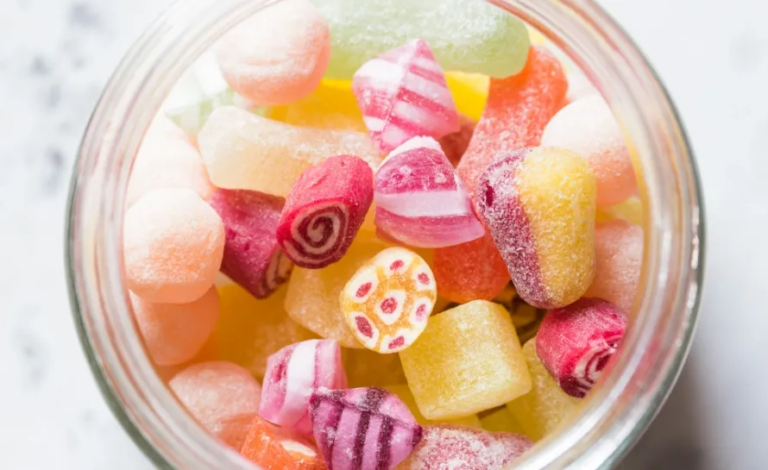
“Mon bonbon” (my candy) and “mon sucre d’orge” (barley sugar) lean heavily into the sweetness angle. “Mon petit pain” (my little bread) is wonderfully French, even carbs can be romantic.
French terms of endearment with food
Mon chou
Mon petit chou
Mon bout de chou
Mon bonbon
Ma crevette
Ma fraise
Ma praline
Ma chouquette
Mon sucre d’orge
Mon petit pain
Ma cerise
French terms of endearment – The classics
Of course, not everything is barnyard animals and vegetables. The French have plenty of straightforward romantic terms too.
“Mon chéri” and “ma chérie” (my darling) are everywhere, probably the most universally used terms. “Mon amour” (my love) is as classic as it gets. “Mon cœur” (my heart) is deeply romantic.
“Mon ange” (my angel), “mon trésor” (my treasure), “ma perle” (my pearl), “mon étoile” (my star), these are poetic without being overly flowery. “Ma belle” or “mon beau” (my beautiful) works for partners.
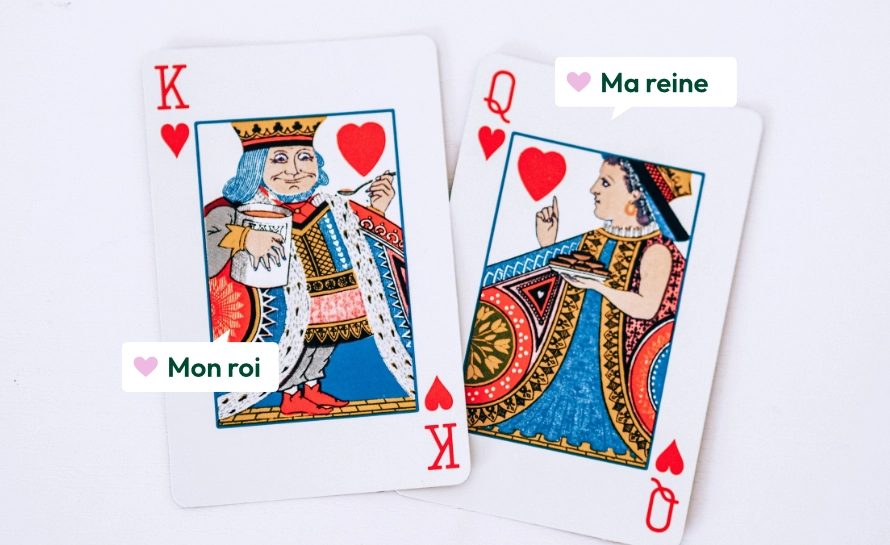
“Ma princesse” (my princess) for daughters or partners, “mon prince” (my prince) for sons or partners. “Ma reine” and “mon roi” (my queen, my king) take it up a notch.
French terms of endearment – The classics
Mon chéri
Ma chérie
Mon amour
Ma princesse
Mon roi
Mon cœur
Mon ange
Mon trésor
Mon prince
Ma perle
Ma belle
Mon beau
Ma reine
French terms of endearment – The quirky ones
Then there’s a whole category of nicknames that don’t quite translate at all. These are pure French linguistic playfulness.
“Mon doudou” is massive, it technically means a comfort blanket or teddy bear, but it’s used for everyone. Partners call each other “doudou,” parents call children “doudou,” it’s universal and cozy.
“Mon loulou” or “ma louloute”, nobody quite knows where this came from, but it’s adorable and very common. Sometimes extended to “mon loulou d’amour.”
“Bébé” isn’t just for babies, couples use it constantly. “Ma poupée” (my doll) works similarly.
“Ma nenette,” “ma nana” (my girl), “mon kiki,” “ma bibiche”, these are playful, a bit silly, the kind of thing you’d only use with someone you’re very comfortable with.
For children specifically, you get “mon pitchoun” (especially in the South), “mon ti-bout,” “ma chipie” (little rascal).
French terms of endearment – The classics
Mon doudou
Mon loulou
Ma louloute
Mon pitchoun
Bébé
Ma poupée
Ma nenette
Mon ti-bout
Ma nana
Mon kiki
Ma bibiche
Ma chipie
A word of warning for learners
If you’re trying these out as a non-native speaker, start with the classics. “Mon chéri” and “mon amour” are safe bets. “Doudou” is cute without being too intimate.
Maybe hold off on calling your new French boyfriend “mon petit chou” until you’re sure of the relationship status. And definitely don’t call your French colleague “ma puce” unless you want things to get awkward.
The food and animal ones can sound a bit daft if your accent isn’t quite there yet. There’s something about a British person earnestly calling someone “my shrimp” in French that doesn’t always land right.
But the French genuinely appreciate when you try. Even if you feel ridiculous calling someone your little cabbage, they’ll find it endearing that you’re embracing this particularly French form of affection.
Over to you
My personal favourite has always been “ma puce” – it sounds soft and a bit silly at the same time. As for “ma belle,” that’s my go-to for all the gorgeous women in my life, my neighbours, my family, my friends, because they really are beautiful, inside and out.
What about you? Tell me, have you been called any of these by a French person? And have any of them successfully made it into your English vocabulary? Share your stories in the comments!