Meringues
Meringues
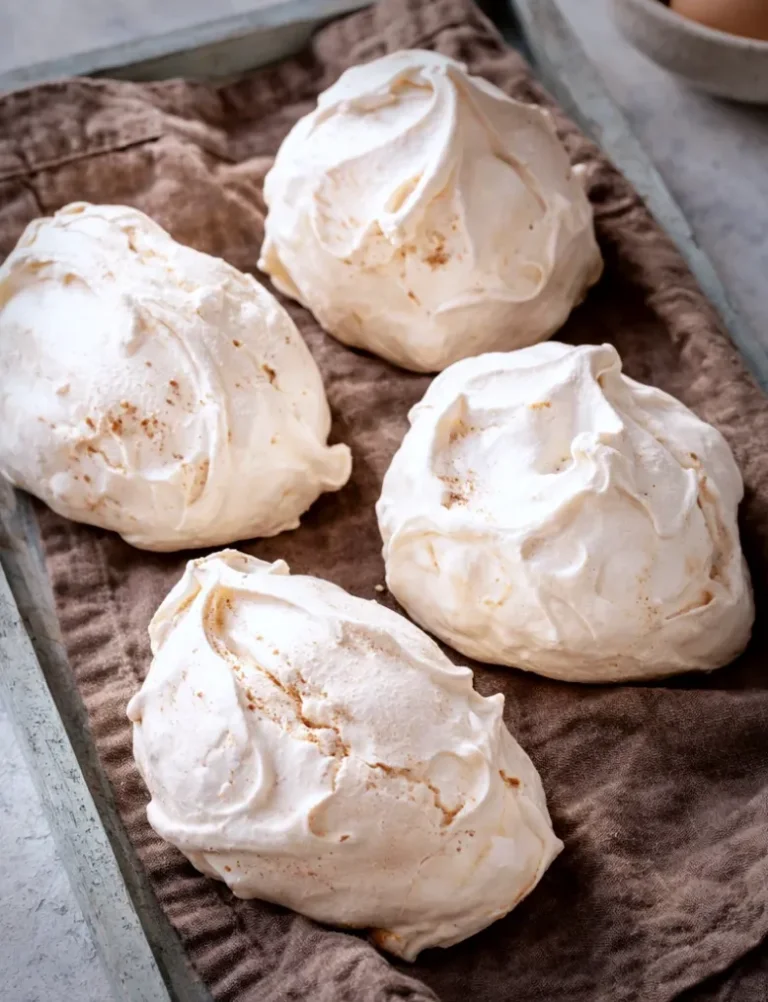
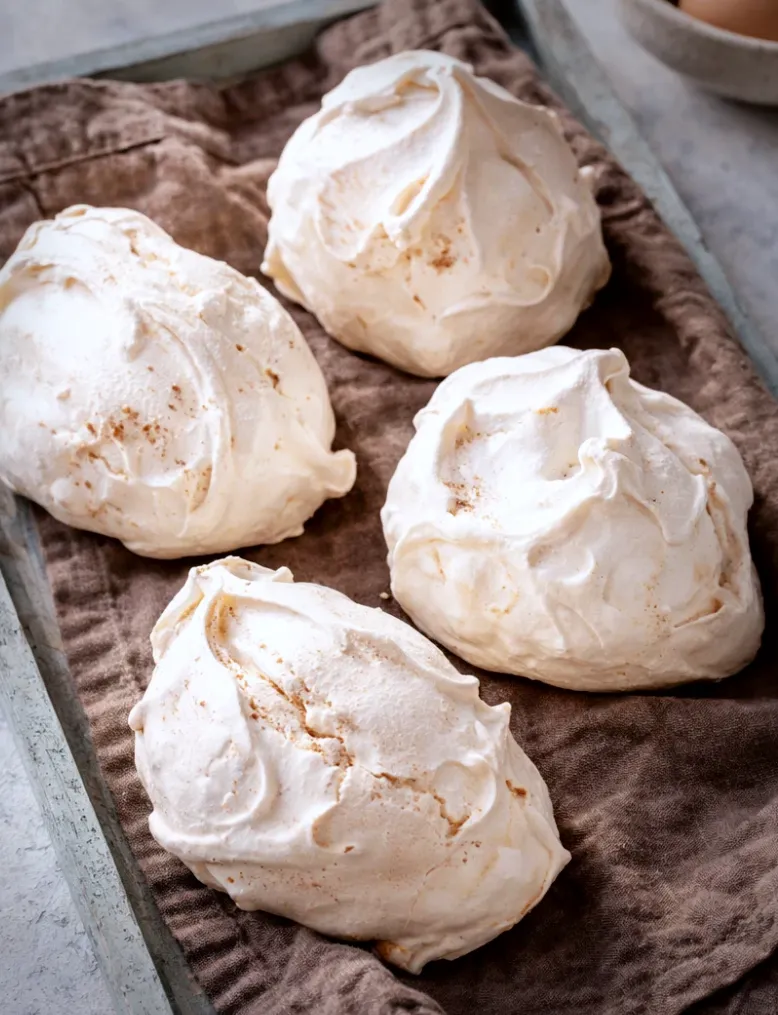
The outside shatters, giving way to crisp layers that dissolve instantly on your tongue. These are perfect French meringues, impossibly light yet somehow rich, with nothing but pure sweetness and a whisper of vanilla and almond. These large bakery-style meringues are what you see in every French pâtisserie window: crackling exterior, airy interior.
Pin Recipe Print Recipe Prep Time 15 minutes Cook Time 2 hours Total Time 3 hours 15 minutes Servings 6 large meringues
 Prep Time 15 minutes
  Cook Time 2 hours
  Total Time 3 hours 15 minutes
  Servings 6 large meringues
Ingredients

- 3 eggs about 90gr, at room temperature
- 90 gr caster sugar
- 90 gr icing sugar
- 1 pinch salt
Equipment
- spoons
Instructions
- 1. Prepare your setupHeat your oven to 100°C (90°C fan/210°F). Line your baking tray with a baking mat or parchment paper.This is crucial: your bowl and whisk must be completely clean and grease-free. Even a trace of fat will prevent the egg whites from whipping properly. Wipe the bowl and whisk with a paper towel dampened with white vinegar or lemon juice, then dry thoroughly. This removes any residual grease.Separate your eggs carefully. If even a speck of yolk gets into the whites, start over, the fat in the yolk will ruin everything. Let the egg whites come to room temperature for 20-30 minutes before whisking. Cold egg whites don't whip as well.
- 2. Start whisking the egg whitesPour the egg whites into your clean bowl. Add the pinch of salt.Start whisking on medium speed. The whites will go through several stages: first foamy and full of large bubbles, then forming soft peaks that flop over when you lift the whisk. This takes about 2-3 minutes. Don't rush this stage by going too fast, you want to incorporate air gradually for a stable meringue.
- 3. Add the caster sugar graduallyOnce you have soft peaks, start adding the caster sugar very gradually with the mixer still running on medium speed. Add it one tablespoon at a time, waiting about 15-20 seconds between additions. This slow addition is essential, dump all the sugar in at once and you'll deflate the whites.As you add the sugar, the meringue will start to look glossy and smooth. The bubbles will become smaller and more uniform. Keep whisking.
- 4. Whisk to stiff peaksAfter all the caster sugar is incorporated, increase the speed to medium-high and continue whisking until the meringue reaches stiff, glossy peaks. This takes another 5-7 minutes total.You'll know it's ready when you lift the whisk and the peak stands straight up without flopping over. The meringue should look smooth, glossy, and thick, almost like shaving cream. Rub a bit between your fingers; it should feel completely smooth with no grains of sugar. If you still feel grit, keep whisking for another minute or two until the sugar is completely dissolved.Don't overwhisk. If the meringue starts to look grainy or separated, you've gone too far.
- 5. Fold in the icing sugarSift the icing sugar over the meringue. Using a rubber spatula, gently fold it in with large, sweeping motions. You want to incorporate the icing sugar without deflating the meringue. The icing sugar adds extra sweetness and helps create that signature crisp, shattering texture. Work gently but deliberately.
- 6. Shape 6 large meringuesUse two large spoons to create 6 generous dome-shaped meringues. Take a heaping spoonful of meringue, then use the second spoon to push it off onto your prepared baking mat, creating a rough dome shape. Space them well apart, at least 5cm between each meringue, as they'll expand slightly during baking.Don't worry about making them perfectly smooth. The rough, swooping texture is part of their charm and creates those beautiful ridges that turn golden at the edges. You want them to look rustic and bakery-fresh, not piped and uniform.
- 7. Bake low and slowSlide the baking tray into the oven and immediately reduce the temperature to 90°C (80°C fan/190°F). This very low temperature dries the meringues rather than baking them, creating that crisp, dry texture all the way through.Bake for 2 hours. Large meringues need this full time to dry out completely. They're done when they lift easily off the parchment and sound hollow when you tap the bottom. The outside should be crisp and the inside should be completely dry, not sticky or chewy.The meringues will develop a pale ivory color, that's traditional and exactly what you want. If you prefer pure white, don't let the oven go above 90°C.
- 8. Cool completelyTurn off the oven and crack the door open slightly. Leave the meringues inside to cool completely, about 1 hour. This gradual cooling prevents cracking.Once cool, the meringues should be crisp all the way through. If they're still soft or sticky in the center, return them to the low oven for another 30 minutes.
Notes
- The traditional French ratio: French meringue uses the “tant-pour-tant” (equal weights) method: the same weight of egg whites, caster sugar, and icing sugar. Total sugar = 2x the weight of egg whites. For this recipe: 90g egg whites + 90g caster sugar + 90g icing sugar = 180g total sugar. This is the classic French proportion found in virtually all traditional recipes.
- Why two types of sugar? The caster sugar is whisked into the whites to stabilize them and create structure. The icing sugar is folded in at the end, it adds extra sweetness and helps create that signature crisp, shattering texture. Both are essential to proper French meringue.
- Room temperature matters: Room temperature egg whites whip to greater volume than cold ones.
- Don’t make meringues on a rainy or humid day. The sugar absorbs moisture from the air. On humid days, your meringues will never crisp up properly and will turn sticky and soft. Wait for a dry day.
- Store cooled meringues in an airtight container at room temperature for up to 2 weeks. Don’t refrigerate them, the moisture will make them sticky. If they do get soft, you can re-crisp them in a low oven (90°C) for 15-20 minutes.
- Troubleshooting weeping meringues: If your baked meringues develop sticky beads of moisture on the surface, you either didn’t whisk long enough to dissolve all the sugar, or you baked them at too high a temperature. The sugar is weeping out. They’re still edible, just not as pretty.
- Traditional French meringues have no added flavoring, just the pure sweetness of sugar and egg whites. If you want to add a little something, you can add vanilla, use 1/2 tsp vanilla extract folded in with the icing sugar.
About this recipe
French meringues is the simplest of the three classic meringue types in French pâtisserie. Unlike Swiss meringue (where you heat the egg whites and sugar over a bain-marie) or Italian meringue (where you pour hot sugar syrup into the whites), French meringue is made entirely cold. You whisk egg whites with sugar until stiff and glossy, then bake them low and slow until crisp.
The technique dates back to at least the early 18th century. The first written recipe for meringues appears in François Massialot’s cookbook from 1692, though the technique was likely known before that. The name itself is disputed, some say it comes from the Swiss town of Meiringen, others claim it’s from the Polish town of Mährren, and still others think it’s simply French in origin. By the time Marie-Antoine Carême was codifying French pastry techniques in the early 1800s, meringue was already a cornerstone of the repertoire.
The traditional French method is straightforward and the French don’t use cream of tartar, lemon juice, vinegar, or other stabilizers, these are additions from other baking traditions. The French method relies purely on technique: proper whisking until the sugar is completely dissolved.
French meringue is the least stable of the three types because it’s never cooked before baking. The egg whites remain raw until they hit the oven. This means it’s perfect for baked applications, meringue cookies, meringue shells, pavlovas, baked Alaska, and the peaks on lemon meringue pie. But it’s not suitable for unbaked uses like buttercream or mousse bases. For those, you need Swiss or Italian meringue, where the heat pasteurizes the eggs.
In France, meringues are everywhere. I used to get one at 16:30 for my “goûter” after school. You’ll find them in pâtisseries sold loose, usually plain white ones, sometimes with a pale golden tinge. They’re the base for elaborate desserts like Vacherin (meringue layered with ice cream), Mont Blanc (meringue topped with chestnut cream), and Oeufs à la Neige (floating islands of poached meringue in crème anglaise).
The French are particular about texture. A proper meringue should shatter when you bite it, then dissolve almost instantly on the tongue, leaving only sweetness behind. It should never be chewy or marshmallowy (unless you’re making pavlova, which is a different thing entirely). The inside should be as dry and crisp as the outside.
Home bakers in France often make meringues when they have leftover egg whites from other recipes. It’s an economical way to use up what would otherwise go to waste. The meringues keep for weeks in an airtight container, making them a practical make-ahead treat.
Simple, economical, impressive. That’s French meringues.
Share your feedback and spread the love!
If you try this meringues recipe, I’d love to hear how it turns out! Leave a ★★★★★ rating and your thoughts in the comments, it helps fellow food lovers discover this recipe too. Snap a photo and tag me @frogsinbritain on Instagram if you’re sharing your bake online. Don’t forget to save this recipe to Pinterest so you’ll always have it handy for your next French-inspired meal!
Disclosure: This post contains sponsored content and/or affiliate links. If you make a purchase through these links, I may receive a small commission at no extra cost to you. All opinions are my own!