Hachis Parmentier

Hachis Parmentier
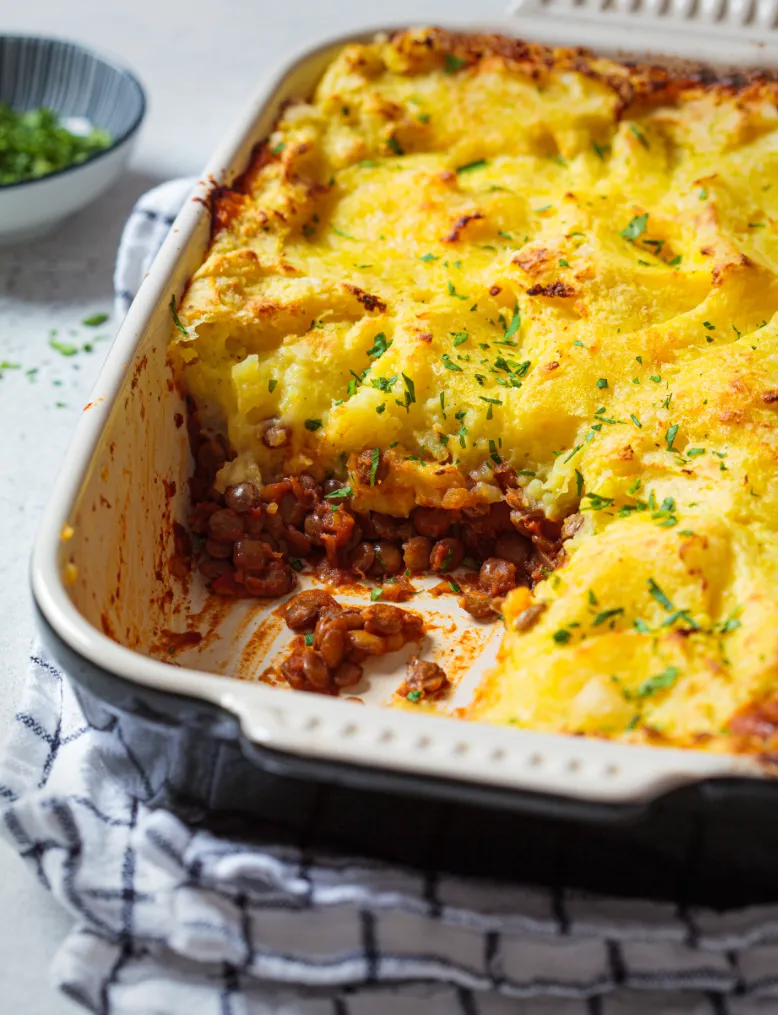
Lentils du Puy simmered with a classic mirepoix of onion, carrot, and celery, thyme, bay leaf, and a touch of tomato concentrate until rich and deeply savoury, then topped with a generous layer of buttery mashed potato and a blanket of Gruyère, gratiné until golden. This vegetarian hachis parmentier is the sort of dish that makes you want to eat straight from the pan, ideally with a good glass of red.
 Prep Time 20 minutes
  Cook Time 55 minutes
  Servings 4
Ingredients

For the lentil filling
For the mashed potato topping
- 900 gr floury potatoes
- 60 gr unsalted butter
- 100 ml whole milk
- 2 tbsp crème fraîche
- 1 pinch nutmeg
- salt and black pepper
To finish
- 80 gr Gruyère cheese
Equipment
- 1 shallow dutch oven cast iron braisier
- 1 saucepan
- potato ricer or masher
Instructions
- 1. Cook the lentils du PuyRinse the lentils under cold water. Unlike many other lentils, lentils du Puy don't need soaking, and crucially they hold their shape through cooking, which is exactly what you want here. Put them in a saucepan, cover with cold water, bring to the boil, and cook for 20 minutes until just tender but still with some bite. Drain and set aside. Don't salt the water during cooking, as it toughens the skins.
- 2. Build the fillingSet your braisier over a medium heat on the hob and add the olive oil. Add the onion, carrot, and celery chopped as "mirepoix" (small cubes) and cook gently for 10 minutes, stirring occasionally, until softened and starting to turn golden. Add the garlic and cook for another 2 minutes.Stir in the tomato concentrate and cook for a further 2 minutes, letting it caramelise slightly against the base of the pan. This is where a lot of the flavour comes from, so don't rush it. Pour in the vegetable stock and add the thyme and bay leaves. Season well with salt and pepper.Add the drained lentils and simmer everything together over a medium-low heat for 15–20 minutes until the stock has reduced down to a rich, cohesive sauce that clings to the lentils rather than sitting around them. The filling needs to hold its shape under the mash. Stir in the red wine vinegar, taste, and adjust the seasoning. Remove the thyme sprigs and bay leaves. Take the braisier off the heat.
- 3. Make the mashWhile the lentils are simmering, cook or steam the potatoes in well-salted boiling water for 20 minutes until completely tender. Drain thoroughly and leave to steam-dry in the colander for a couple of minutes, excess moisture makes for a sloppy mash and you don't want that sitting on top of the lentils.Pass the potatoes through a ricer back into the pan, or mash until completely smooth. Beat in the butter until melted and fully incorporated, then add the warm milk and crème fraîche. Season generously with salt, white pepper, and freshly grated nutmeg. The mash should be smooth, rich, and loose enough to spread easily but not runny.
- 4. Top, finish, and bakePreheat the oven to 200°C / 180°C fan. Spoon the mashed potato directly over the lentil filling in the braisier and spread it carefully to the edges, covering everything completely. Use a fork to create ridges across the surface, this gives you more texture and more crispy bits. Scatter the grated Gruyère evenly over the top.Transfer the braisier to the oven and bake for 25 minutes until the cheese is melted and golden and the edges are starting to bubble. For a properly golden top, finish under the grill for 3–4 minutes. Keep an eye on it.
- 5. Rest and serveLeave it to rest for 5 minutes before serving, the filling will be extremely hot and needs a moment to settle. Bring the braisier straight to the table and serve directly from it with a simple green salad dressed with a sharp mustard vinaigrette on the side.
Notes
- Lentils du Puy specifically is what makes this work. They hold their shape through cooking and have a mineral, earthy flavour that generic green lentils simply can’t match. Look for the AOP label if you can find it.
- Don’t rush the mirepoix. Ten minutes of gentle cooking builds the flavour base the whole dish rests on. If the vegetables go in barely softened, the filling will taste flat.
- The tomato concentrate is there as background, not as a feature. Two tablespoons is enough to add depth and a little colour without announcing itself. This dish is about the lentils.
- A wide, shallow braisier works better here than a deep casserole. You want a good ratio of mash to filling in each spoonful, and a deeper dish throws that off. The wider the better for the gratin on top too.
- Make ahead: build the whole thing up to the baking stage, leave to cool, and refrigerate for up to 24 hours. Take it out of the fridge 30 minutes before baking and add 10 minutes to the oven time.
- Leftovers keep well in the fridge for 2–3 days and reheat brilliantly in the oven at 180°C for 20 minutes, covered with foil.
- Comté works just as well as Gruyère on top, and arguably better, it has a slightly nuttier, more complex flavour that’s worth trying if you can find it.
✱ Drink pairing
About this recipe
Hachis parmentier takes its name from Antoine-Augustin Parmentier, the 18th-century French agronomist who campaigned tirelessly to get the French to eat potatoes. At the time, potatoes were considered animal feed and widely distrusted as food for humans. Parmentier’s campaign was, by any measure, one of history’s more successful public relations exercises. He reportedly had King Louis XVI wear potato flowers in his buttonhole at court, and planted fields of potatoes under armed guard, knowing that the guards would be removed at night and that people would assume anything this well-protected was worth stealing. They stole the potatoes. The potato’s reputation in France was secured.
The dish named after him became a classic of French home cooking, the kind of thing that appears in French culinary dictionaries under “cuisine bourgeoise”: solid, unpretentious, built for feeding families rather than impressing guests.
Replacing the meat with lentilles du Puy is a modern adaptation, but one that makes particular sense. The lentilles du Puy are the finest lentils in France, grown on the volcanic plateaux of the Haute-Loire in Auvergne at altitudes between 600 and 1,200 metres. They’ve been cultivated in the region since Gallo-Roman times, a terracotta jar containing lentils was excavated at Saint-Paulien, near Le Puy-en-Velay, dating from that period. The oldest written record of their cultivation dates to 1643, when the local chronicler Antoine Jacmon listed them among the region’s produce.
What makes them exceptional is their terroir. The Velay plateaus are surrounded by mountain ranges, the Cantal and the Monts de la Margeride to the west, the Monts du Vivarais to the southeast, which create a natural barrier against moisture. In summer, a foehn effect produces hot, dry winds across the growing area, stressing the lentil plants and interrupting their maturation before it’s complete. The result is a lentil with an unusually thin skin, a non-floury texture, and a subtle, mineral flavour that no other growing region has managed to replicate. They’ve been called “le caviar du pauvre”, the poor man’s caviar, for as long as anyone can remember.
In 1996, the lentille verte du Puy became the first vegetable in France to receive an AOC designation, and in 2008 it gained European AOP protection. The rules are strict: the lentils must be grown, sorted, and packaged within a tightly defined area of 87 communes in the Haute-Loire. No irrigation, no synthetic fertilisers. The variety cultivated, Lens esculenta puyensis, was formally named in 1930 by Russian botanist Elena Barulina, who named it directly after Le Puy-en-Velay in recognition of the region’s long association with exceptional lentil production.
Paul Bocuse, Bernard Loiseau, and Régis Marcon have all celebrated lentilles du Puy in their cooking. Régis Marcon in particular, whose three-Michelin-star restaurant is based in Saint-Bonnet-le-Froid in the Haute-Loire, has made them a signature ingredient. When the finest chefs in France consider a humble legume worth cooking with seriously, it’s worth paying attention.
In this vegetarian hachis parmentier they do what they do best: hold their shape, absorb the aromatics of the mirepoix and thyme, and deliver an earthiness that gives the dish real depth. The mashed potato topping and the Gruyère gratin are pure hachis parmentier tradition. The lentils are simply doing a job the French have always known they were good at.
Share your feedback and spread the love!
If you try this Hachis Parmentier recipe, I’d love to hear how it turns out! Leave a ★★★★★ rating and your thoughts in the comments, it helps fellow food lovers discover this recipe too. Snap a photo and tag me @frogsinbritain on Instagram if you’re sharing your bake online. Don’t forget to save this recipe to Pinterest so you’ll always have it handy for your next French-inspired meal!
Disclosure: This post contains sponsored content and/or affiliate links. If you make a purchase through these links, I may receive a small commission at no extra cost to you. All opinions are my own!